
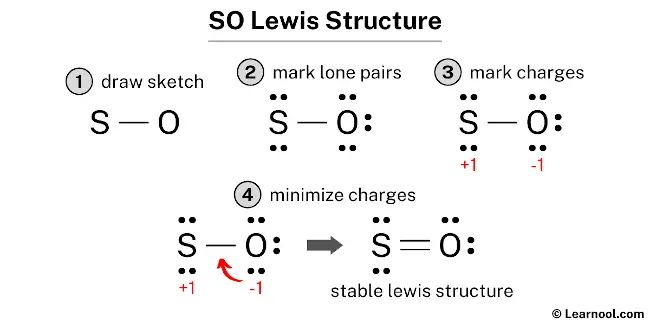
The SO Lewis structure represents the arrangement of a molecule consisting of one sulfur atom and one oxygen atom, also known as sulfur monoxide. This structure displays a double bond between the sulfur and oxygen atoms, and each atom has two lone pairs. The presence of this double bond and lone pairs allows both atoms to satisfy the octet rule, making the Lewis structure stable.
To draw the SO Lewis structure, start by sketching a rough skeleton of the molecule. Then, indicate the location of lone pairs on the atoms. If necessary, assign formal charges to the atoms. Next, adjust the placement of lone pairs on the atoms to minimize formal charges and aim for a stable Lewis structure. Repeat this process if needed until all charges are minimized and the octet rule is fulfilled for both atoms. Following this step-by-step approach can lead to a simple and accurate drawing of the SO Lewis structure.
Alternative method: Lewis structure of SO
Rough sketch
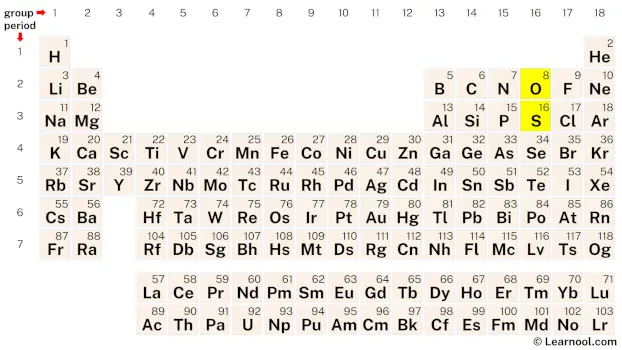
To begin sketching the SO Lewis structure, it is important to first determine the total number of valence electrons. Both sulfur and oxygen lie in group 16 of the periodic table, which means that they each have six valence electrons. As the SO molecule consists of one sulfur atom and one oxygen atom, the valence electrons of one sulfur atom and one oxygen atom are added together. This gives a total of 12 valence electrons for the SO molecule.
Learn how to find: Sulfur valence electrons and Oxygen valence electrons
After finding the valence electrons, the next step is to determine the total number of electron pairs. Since the molecule has a total of 12 valence electrons, dividing this number by two gives the total number of electron pairs. Therefore, the total number of electron pairs in the SO molecule is 6.
After finding the valence electrons and total electron pairs, the next step is to determine the central atom. Since the central atom in a Lewis structure is typically the least electronegative atom, sulfur is assumed to be the central atom in SO since it has a lower electronegativity than oxygen. Once the central atom has been determined, the rough sketch can now be drawn.

Lone pair
After sketching the rough diagram for the SO Lewis structure, the next step is to indicate the lone pairs. With a total of 6 electron pairs, and one S – O bond already marked in the sketch, which represents the utilization of one electron pair, the remaining 5 electron pairs need to be indicated as lone pairs on the sketch.
Keep in mind that sulfur is a period 3 element and can accommodate more than 8 electrons in its last shell, while oxygen is a period 2 element and can only hold up to 8 electrons in its outermost shell.
When marking the lone pairs in the structure, it’s important to start with the outside atom, which in this case is oxygen. Oxygen will receive three lone pairs, while sulfur will receive two lone pairs. To mark the lone pairs on the sketch, simply draw two dots for each pair next to the corresponding atom. This will ensure that each atom satisfies the octet rule.

Formal charge
To calculate the formal charges on the atoms in SO, use the formula: Formal charge = valence electrons – nonbonding electrons – ½ bonding electrons. For the sulfur atom, the formal charge is obtained by subtracting 4 nonbonding electrons and ½ of 2 bonding electrons from 6 valence electrons, which gives a result of +1. Similarly, for the oxygen atom, the formal charge is found by subtracting 6 nonbonding electrons and ½ of 2 bonding electrons from 6 valence electrons, resulting in a charge of -1.
To reflect the charges on the sulfur and oxygen atoms, it is important to mark them on the sketch.

The current Lewis structure with formal charges on both sulfur and oxygen is not stable. In order to get a stable structure, the charges on the atoms need to be minimized. This can be achieved by converting lone pairs to bonds.
To minimize the charges on the atoms and attain a stable SO Lewis structure, one of the lone pairs on the oxygen atom needs to be converted into a new bond with the sulfur atom. This can be done by drawing a line between the oxygen and sulfur atoms to indicate the new bond.

Final structure
The final structure of SO consists of a sulfur atom linked to an oxygen atom through a double covalent bond. In this arrangement, both the sulfur and oxygen atoms successfully satisfy the octet rule by maintaining two lone pairs each alongside the shared electrons. This configuration results in formal charges of zero for both atoms, representing the most stable and energetically favorable distribution of electrons for this diatomic species. Consequently, this specific bonding pattern represents the definitive and most accurate Lewis representation of sulfur monoxide.
Next: S2O Lewis structure
External links
- SO Lewis Structure in 5 Steps (With Images) – Pediabay
- Lewis Dot Structures – Chemistry LibreTexts
- Draw the Lewis structure for sulfur monoxide (SO) molecule – Brainly

Deep
Learnool.com was founded by Deep Rana, who is a mechanical engineer by profession and a blogger by passion. He has a good conceptual knowledge on different educational topics and he provides the same on this website. He loves to learn something new everyday and believes that the best utilization of free time is developing a new skill.