
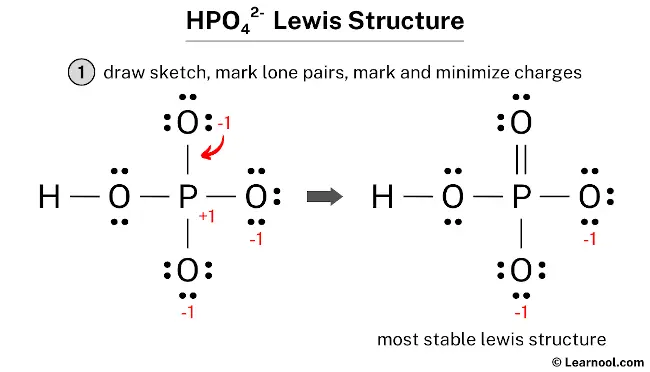
HPO42- (hydrogen phosphate) has one hydrogen atom, one phosphorus atom, and four oxygen atoms.
In the HPO42- Lewis structure, there is one double bond and three single bonds around the phosphorus atom, with four oxygen atoms attached to it. The oxygen atom with a double bond has two lone pairs, the left oxygen atom (with which the hydrogen atom is attached) also has two lone pairs, and the other two oxygen atoms with single bonds have three lone pairs.
Also, there is a negative (-1) charge on the two oxygen atoms with single bonds.
Alternative method: Lewis structure of HPO42-
Rough sketch
- First, determine the total number of valence electrons
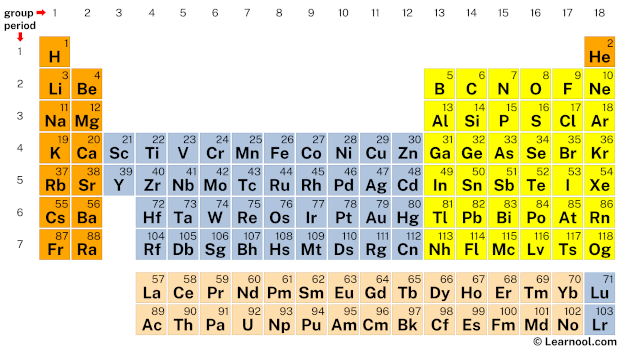
In the periodic table, hydrogen lies in group 1, phosphorus lies in group 15, and oxygen lies in group 16.
Hence, hydrogen has one valence electron, phosphorus has five valence electrons, and oxygen has six valence electrons.
Since HPO42- has one hydrogen atom, one phosphorus atom, and four oxygen atoms, so…
Valence electrons of one hydrogen atom = 1 × 1 = 1
Valence electrons of one phosphorus atom = 5 × 1 = 5
Valence electrons of four oxygen atoms = 6 × 4 = 24
Now the HPO42- has a negative (-2) charge, so we have to add two more electrons.
So the total valence electrons = 1 + 5 + 24 +2 = 32
Learn how to find: Hydrogen valence electrons, Phosphorus valence electrons, and Oxygen valence electrons
- Second, find the total electron pairs
We have a total of 32 valence electrons. And when we divide this value by two, we get the value of total electron pairs.
Total electron pairs = total valence electrons ÷ 2
So the total electron pairs = 32 ÷ 2 = 16
- Third, determine the central atom
Here hydrogen can not be the central atom. Because the central atom is bonded with at least two other atoms, and hydrogen has only one electron in its last shell, so it can not make more than one bond.
Now we have to choose the central atom from phosphorus and oxygen. Place the least electronegative atom at the center.
Since phosphorus is less electronegative than oxygen, assume that the central atom is phosphorus.
Therefore, place phosphorus in the center and hydrogen and oxygen on either side.
- And finally, draw the rough sketch

Lone pair
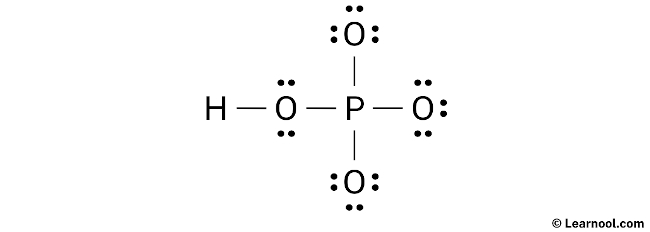
Here, we have a total of 16 electron pairs. And five bonds are already marked. So we have to only mark the remaining eleven electron pairs as lone pairs on the sketch.
Also remember that hydrogen is a period 1 element, so it can not keep more than 2 electrons in its last shell. Phosphorus is a period 3 element, so it can keep more than 8 electrons in its last shell. And oxygen is a period 2 element, so it can not keep more than 8 electrons in its last shell.
Always start to mark the lone pairs from outside atoms. Here, the outside atoms are hydrogen and oxygens. But no need to mark on hydrogen, because hydrogen already has two electrons.
So for top oxygen, bottom oxygen, and right oxygen, there are three lone pairs. For left oxygen, there are two lone pairs, and for phosphorus, there is zero lone pair because all eleven electron pairs are over.
Mark the lone pairs on the sketch as follows:
Formal charge
Use the following formula to calculate the formal charges on atoms:
Formal charge = valence electrons – nonbonding electrons – ½ bonding electrons
For hydrogen atom, formal charge = 1 – 0 – ½ (2) = 0
For phosphorus atom, formal charge = 5 – 0 – ½ (8) = +1
For top oxygen, bottom oxygen, and right oxygen atom, formal charge = 6 – 6 – ½ (2) = -1
For left oxygen atom, formal charge = 6 – 4 – ½ (4) = 0
Here, both phosphorus and oxygen atoms have charges, so mark them on the sketch as follows:
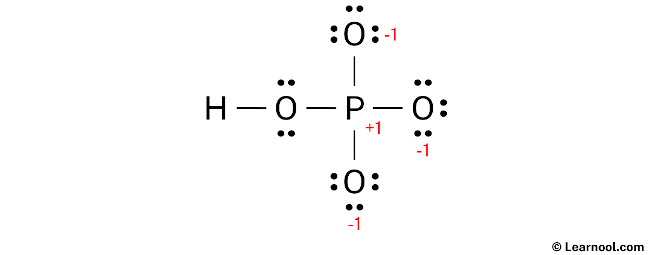
The above structure is not a stable Lewis structure because both phosphorus and oxygen atoms have charges. Therefore, reduce the charges (as below) by converting lone pairs to bonds.
Convert a lone pair of the top oxygen atom to make a new P — O bond with the phosphorus atom as follows:
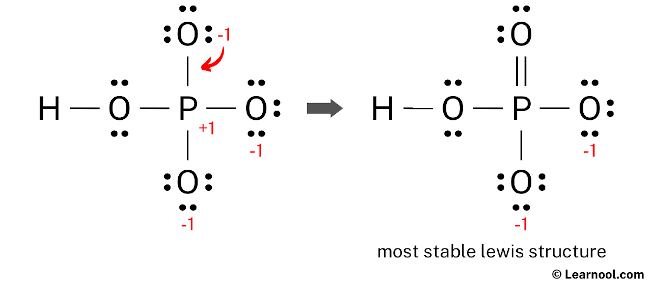
Final structure
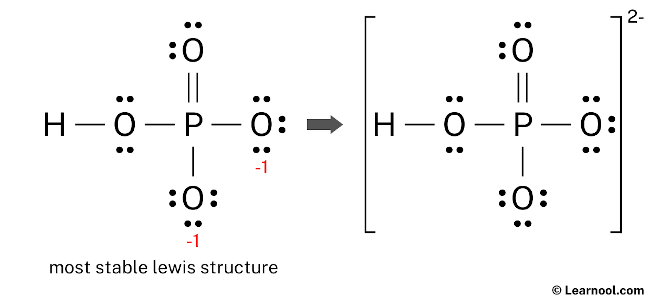
The final structure of HPO42- includes a central phosphorus atom connected to four oxygen atoms, one of which is bonded to a hydrogen atom. Within this configuration, the phosphorus atom utilizes an expanded valence shell to form one double bond with a lone oxygen atom and single bonds with the three remaining oxygen atoms. In this arrangement, the phosphorus atom, the double-bonded oxygen, and the hydroxyl (-OH) group maintain formal charges of zero, while the two single-bonded oxygen atoms that lack hydrogen atoms each carry a -1 formal charge. The double-bonded oxygen fulfills its octet with two lone pairs, the hydroxyl oxygen retains two lone pairs, and the two negatively charged oxygen atoms each maintain three lone pairs. Accordingly, this specific electronic distribution serves as the definitive and most accurate Lewis representation of the hydrogen phosphate ion.
To complete the representation, draw square brackets around the entire Lewis structure and place a “2-” sign as a superscript outside the upper right bracket. This notation signifies that the negative charge is a property of the whole ion, reflecting the presence of two additional electrons beyond the total valence count of the neutral atoms.
Next: CH3SH Lewis structure
External video
- How to Draw the Lewis Dot Structure for HPO4 2- | Hydrogen phosphate ion – YouTube • Wayne Breslyn
External links

Deep
Learnool.com was founded by Deep Rana, who is a mechanical engineer by profession and a blogger by passion. He has a good conceptual knowledge on different educational topics and he provides the same on this website. He loves to learn something new everyday and believes that the best utilization of free time is developing a new skill.